
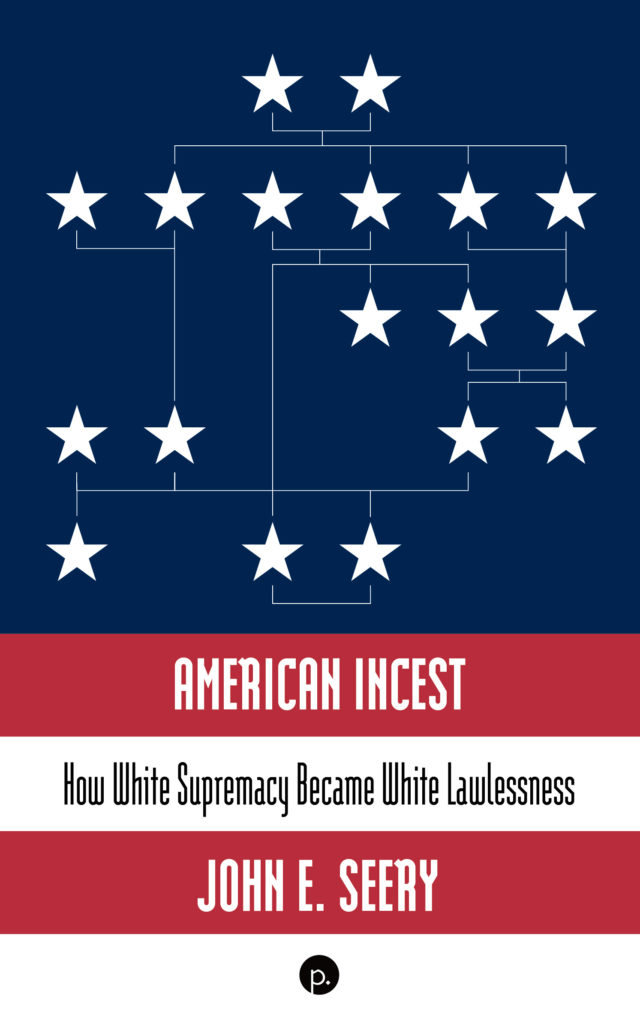
American Incest takes its readers on a whirlwind, barn-burning, eye-opening yet largely uncharted tour of America. Consider these examples: The first American novel was an incest novel, published in 1789 and intended as a rival document to the US Constitution. The most famous American painting is a painting about incest. The most influential American movie ever made was an incest movie. The slogan of Philadelphia, America’s founding city, should be properly translated and historically understood as “City of Incest,” not “City of Brotherly Love.” Elvis was the King of Rock ‘n’ Roll, but also, the King of Incest.
Seery takes seriously these and other very public (if unavowed) expressions of incest and helps explain the US preoccupation with incest, namely as a roundabout endorsement and oblique enactment of white supremacy. These pivotal episodes in American white supremacy have also always been teetering toward white lawlessness, a recurrent rupture of the social contract (and a recurrent oversight in social contract theory), all racing toward and culminating in Trumpism. Each chapter tells a tale that hasn’t been told or else not told sufficiently enough, though these are tales that should each have been told and told together, as endemic to American cultural and political history.
American Incest is a wide-ranging work, drawing both broadly and rigorously from numerous fields, including the author’s own field of political theory. That a work of political theory should draw so heavily on an uninterrupted tradition of American literary incest is also new and notable (an original list of 300+ incest works in the American canon is assembled for the first time as an Appendix to the book).
About the Author
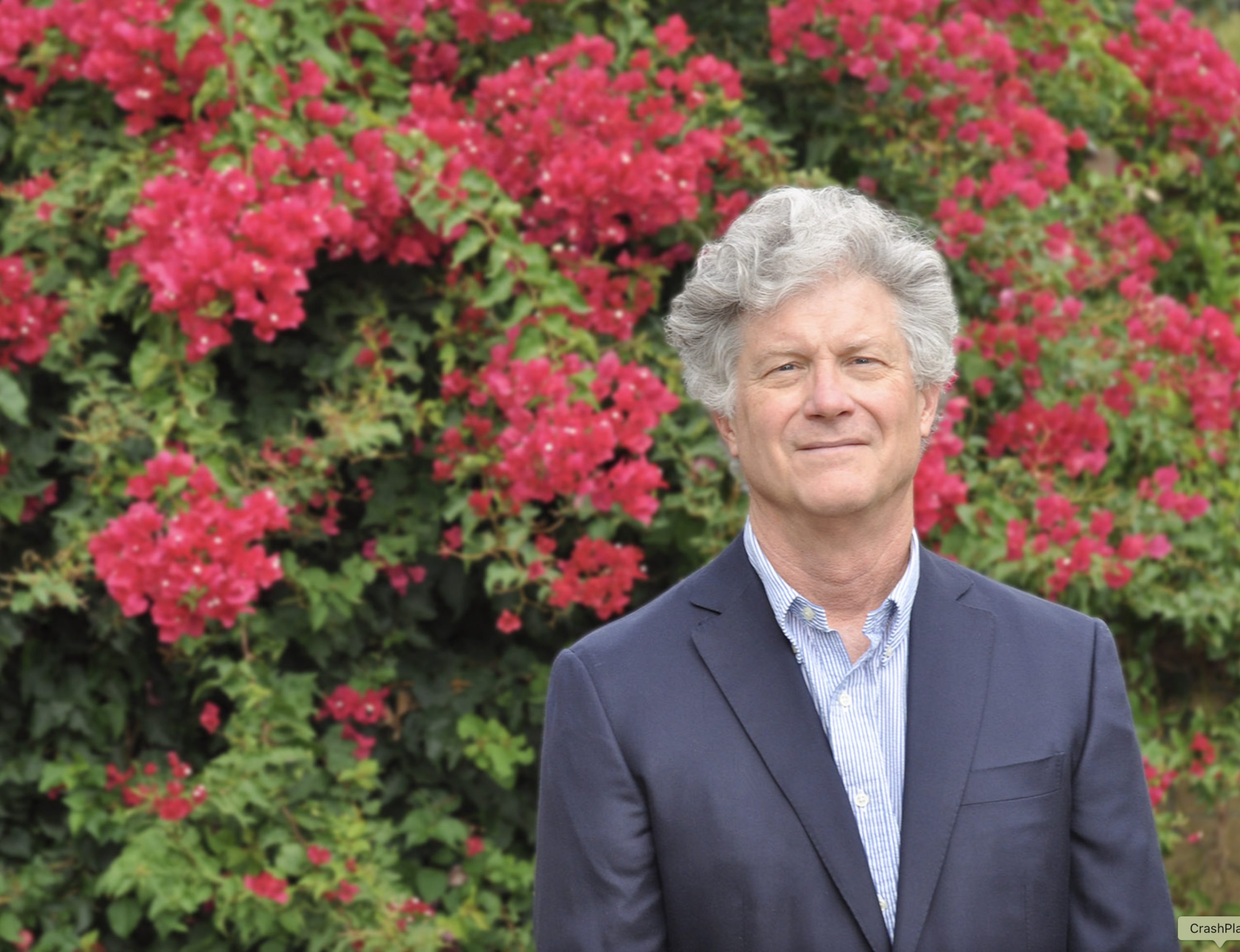 John E. Seery is the George Irving Thompson Memorial Professor of Government and Professor of Politics at Pomona College, where he teaches political theory. He is author or editor of ten books, on topics such as: irony; death; liberal arts education; liberal arts colleges; the U.S. Constitution’s age requirements for elected federal office; George Kateb; and Walt Whitman. He has written articles about John Coltrane, Hannah Arendt, Friedrich Nietzsche, Thomas Mann, Max Weber, Judith Butler, and Joan of Arc. In 2009 he was named the recipient of the Phi Beta Kappa Society’s Sidney Hook Memorial Award, an award bestowed every three years that “recognizes national distinction by a single scholar in each of three endeavors — scholarship, undergraduate teaching and leadership in the cause of liberal arts education.” In 2010-2011 he served as the Laurance S. Rockefeller Visiting Professor for Distinguished Teaching in Princeton University’s Center for Human Values. In 2013 he received the American Political Science Association’s only discipline-wide teaching award (15,000+ members). Twice he has been the recipient of Pomona College’s Wig Distinguished Teaching Award. In addition to teaching at Pomona, he has taught at Stanford, Tufts, UC Santa Cruz, and Princeton. He plays baritone sax in two bands.