
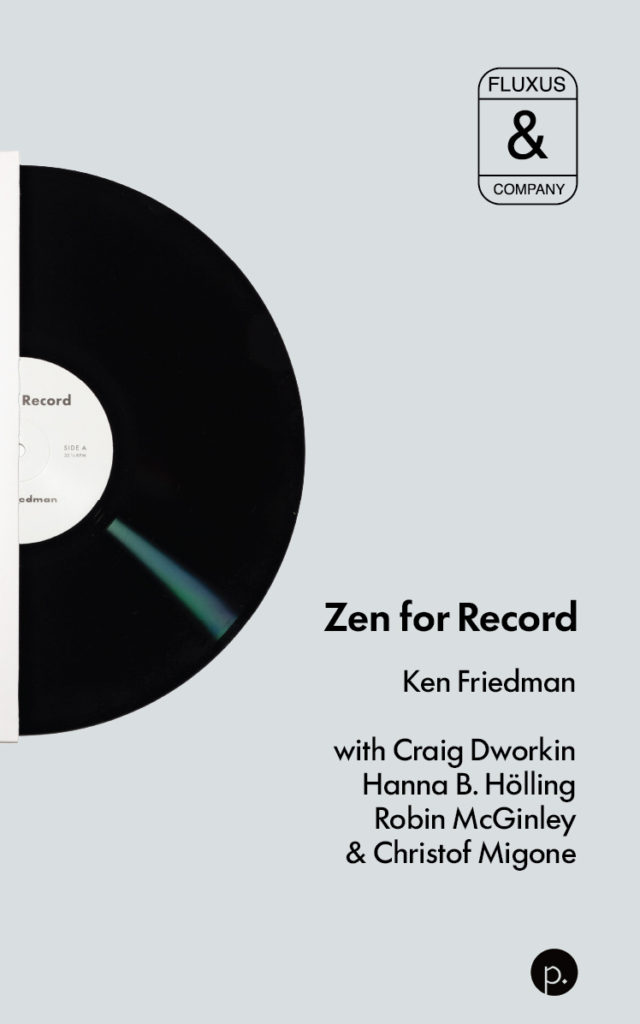

Zen for Record gathers five essays around Ken Friedman’s 1966 Fluxus event score instructing the production of “a phonograph record with no sound on it.” Originating as a found object, the work has migrated across six decades and multiple incarnations, from an unrealized concept to the LP edition that occasions this volume.
These essays accompany Friedman’s account of the Fluxus origins of the work, but they approach the silent record from radically different angles. Craig Dworkin situates Zen for Record within a broader aesthetics of negation and conceptual art’s engagement with the zero-degree of content. Christof Migone spirals through the paradoxes of inscribing nothing and the impossibility of a truly soundless playback. Robin McGinley traces a remarkable counter-history of the silent record as pop artifact, from 1950s jukebox novelties and Vulfpeck’s album Sleepify. Finally, Hanna B. Hölling reads the work through sonic materialism, preservation theory, and the politics of silencing, asking what it means for a concept to survive the obsolescence of its successive carriers.
Touching on Fluxus event scores and Cagean silence, the political economy of streaming platforms and the conservation of time-based media, these essays stage a sustained interdisciplinary meditation on silence as material, medium, commodity, and philosophical provocation.