Chaucer’s Comic Providence

Imprint:

Published: 04/20/2023

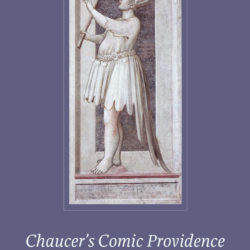
Chaucer’s Comic Providence presents readings of five of Chaucer’s Canterbury Tales that dramatize sexual division and the lack of rapport between the sexes. These readings are founded on the psychoanalytic thinking of Jacques Lacan in his rereading of Freud and are motivated by Thormann’s conviction that Chaucer understood what psychoanalysis would come to study as[…]

The Saga of Þórður kakali: The Icelandic Text, with an English Translation

Published: 12/17/2020

The Old Icelandic text The Saga of Þórður kakali survives today as part of the fourteenth-century compilation The Saga of the Sturlungar. In extant form, The Saga of Þórður kakali is a biography of Þórður kakali Sighvatsson (c.1210–56)—chieftain, royal retainer, and sheriff—and covers the periods 1242–50 and 1254–56, providing an interesting view of power politics[…]

ρan-ρan

Published: 07/01/2021

With the peristaltic gurglings of this gastēr-investigative procedural – a soooo welcomed addition to the ballooning corpus of slot-versatile bad eggs The Confraternity of Neoflagellants (CoN) – [users] and #influencers everywhere will be belly-joyed to hold hands with neomedieval mutter-matter that literally sticks and branches, available from punctum in both frictionless and grip-gettable boke-shaped formats.[…]

Disturbing Times: Medieval Pasts, Reimagined Futures

Published: 06/04/2020

From Kehinde Wiley to W.E.B. Du Bois, from Nubia to Cuba, Willie Doherty’s terror in ancient landscapes to the violence of institutional Neo-Gothic, Reagan’s AIDS policies to Beowulf fanfiction, this richly diverse volume brings together art historians and literature scholars to articulate a more inclusive, intersectional medieval studies. It will be of interest to students[…]

Urban Interactions: Communication and Competition in Late Antiquity and the Early Middle Ages

Imprint:

Published: 10/15/2020

This volume is dedicated to eliciting the interactions between localities across late antique and early medieval Europe and the wider Mediterranean. Significant research has been done in recent years to explore how late “Roman” and post-“Roman” cities, towns and other localities communicated vis-à-vis larger structural phenomena, such as provinces, empires, kingdoms, institutions and so on.[…]