
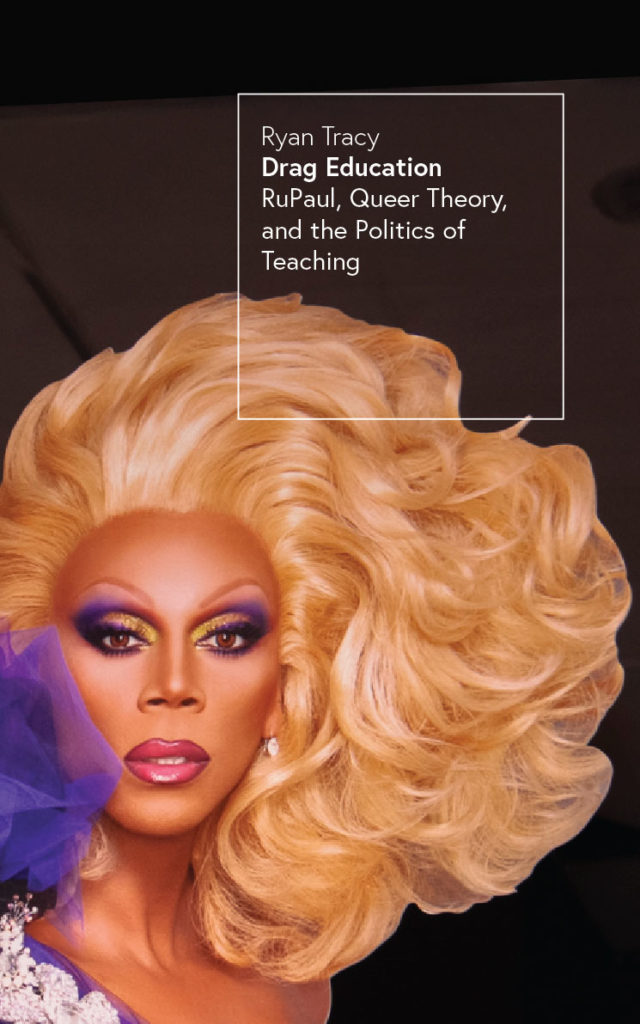

“I think of myself as less of a judge and more of a teacher.” So said the Queen of Drag, RuPaul Andre Charles, on the second season of RuPaul’s Drag Race—the Emmy Award-winning reality show competition that cemented RuPaul’s status as the most influential drag queen in the world. Via her international and still-expanding Drag Race franchise, sixteen studio albums, a podcast, four published memoirs, the Netflix series A.J. and the Queen, and numerous public appearances, comments, and interviews (not to mention Instagram posts), RuPaul has consistently presented herself to the world as an educator for all whose medium is drag.
Drag Education: RuPaul, Queer Theory, and the Politics of Teaching takes RuPaul at her word by exploring in-depth RuPaul’s theorization of drag as a fabulous form of pedagogy. Following RuPaul’s lead, this book proposes a theory of drag education understood as the radical and dispersed set of learning experiences that cross-dressing makes possible. In chapters that weave close readings of RuPaul’s autobiographies with academic writing on RuPaul’s cultural impact, Drag Education makes the argument that drag’s capacity to educate is precisely what has made it a political flashpoint. This book also asks for a conceptual rethinking of drag genealogy. Rather than viewing queer culture as drag’s proper home—a view held by conservatives and even some progressive critics—Drag Education insists that the “ruuts” of drag lie in the domestic sphere, where even the strictest rules against cross-dressing can provoke the very desire to give drag a whirl. Drawing on queer theory’s insight that prohibitions are generative, this book makes the case that “dragucation” (another apt RuPaul neologism) has always been a family affair.
About the Author
 Ryan Tracy is Visiting Assistant Professor of English at Knox College in Galesburg, Illinois. His scholarly writings have appeared in venues such as PMLA, Feminist Modernist Studies, Derrida Today, and Arizona Quarterly. Ryan is the author of two volumes of poetry, Lines in the Shed (2025) and Tender Bottoms (2022). His poetry and fiction have also appeared in Pank (2019 Pushcart Prize nomination for fiction), Sugar House Review, Feral, Twin Bird Review, The Gay and Lesbian Review, and Calliope. Ryan makes pottery, writes music, performs, and drags, among other sassy endeavors.